Section 02 · the literature
The papers, in order.
Mechanism, trials, and what the published record actually shows — sketched, cited, and unembellished.
What the papers actually say
This page reads the sermorelin literature one study at a time, in the order a researcher would actually want them. The mechanism section explains the five-step pituitary cascade in plain English before laying out the chemistry. The trials section covers the 1996 pediatric study that earned FDA approval, the Khorram aging study in adults over 55, and the Baker cognitive trial that used a closely related analog.
A few things to note before reading. Most of the human data come from studies lasting weeks to months, not years — long-term safety for chronic adult use is one of the most-cited gaps in the literature. Where a finding comes from a related analog (tesamorelin, CJC-1295) rather than sermorelin itself, the text says so plainly. Every claim links to a numbered reference at the bottom of the page.
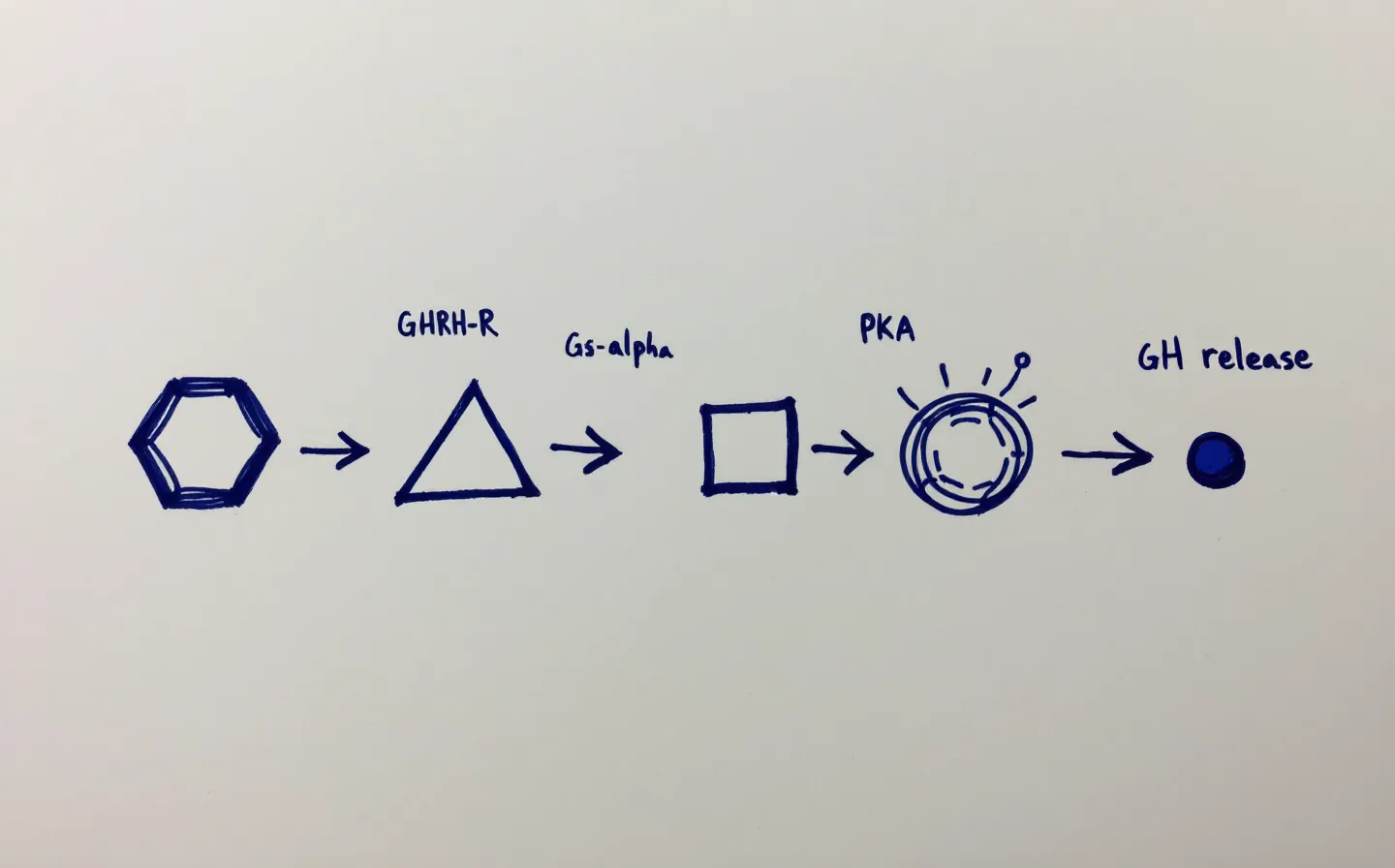
Mechanism: a five-step cascade you can draw
The cascade is short enough to fit on a notebook page. Sermorelin binds GHRH-R on the anterior pituitary somatotroph. The receptor is Gs-coupled, so its activation switches on adenylyl cyclase, which converts ATP to cAMP. Rising intracellular cAMP activates protein kinase A. PKA does two jobs in parallel: it phosphorylates the transcription factor CREB to upregulate GH gene transcription, and it phosphorylates components of the secretory granule machinery so preformed GH gets released into the bloodstream within minutes [1][10].
Voltage-gated calcium channels open as part of the same signaling sequence, providing the calcium influx that exocytosis requires. The 2025 review of GHRH-R signaling describes the canonical pathway in precisely these terms while also documenting MAPK/ERK1/2 activation downstream of the same receptor and a PI3K-Akt arm that has been characterized in non-pituitary tissues, including cardiomyocytes where GHRH-R has cytoprotective effects [10].
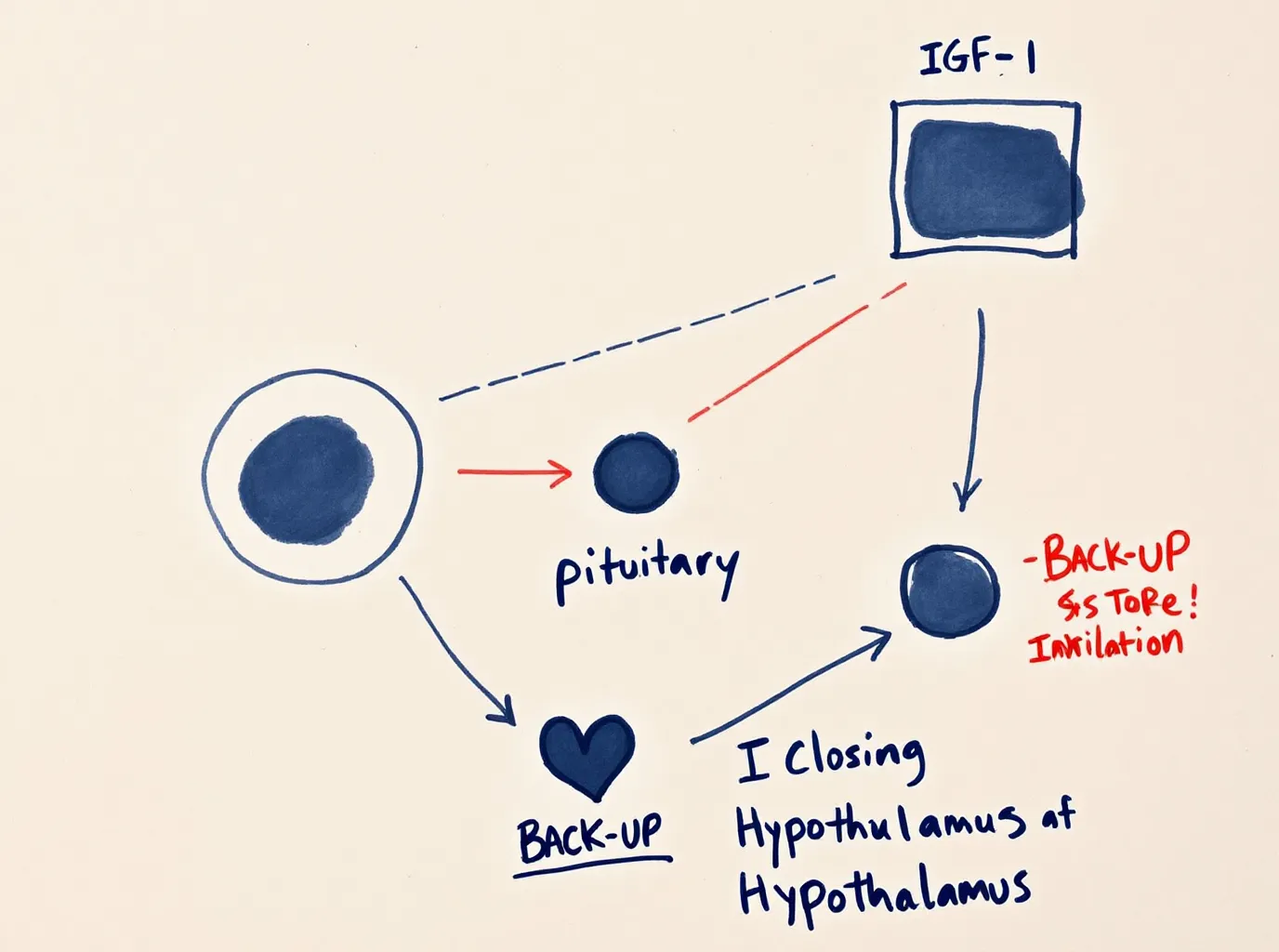
What happens after the GH gets out is a second cascade. Circulating GH binds GH receptors on hepatocytes, activates the JAK2-STAT5 pathway, and induces hepatic production of insulin-like growth factor 1. IGF-1 then mediates most of the anabolic and growth-promoting downstream effects clinically associated with GH activity [1]. This is why the literature uses serum IGF-1 — not GH itself — as the most reliable circulating marker of GH-axis activation.
The 1997 pediatric trial that earned approval
The Geref International Study Group trial published in 1996 in the Journal of Clinical Endocrinology & Metabolism enrolled 110 prepubertal children with documented GH deficiency [2]. They received 30 mcg/kg subcutaneous sermorelin nightly for at least six months.
The primary endpoint was growth velocity. Mean height velocity rose from a baseline of 4.1 ± 0.9 cm/year to 8.0 ± 1.5 cm/year at the six-month mark, and held at 7.2 ± 1.3 cm/year at twelve months. Seventy-four percent of children were classified as responders by the trial's pre-specified velocity threshold. No adverse changes in glucose, insulin, lipid panels, or other biochemical safety markers were reported [2].
This is the trial that supported the 1997 FDA approval of sermorelin acetate as Geref. It remains the cleanest evidence of efficacy in the literature: a defined deficient population, a defined endpoint, a defined dose, and an effect that replicated.
The Khorram aging study and what it found
In 1997, Khorram, Laughlin, and Yen published a 16-week trial of a stabilized GHRH(1-29) analog in 47 healthy adults aged 55 to 71 [3]. Subjects received 10 mcg/kg subcutaneously each night.
Nocturnal 12-hour integrated GH rose significantly in both sexes — P<0.05 in men and P<0.01 in women — and serum IGF-1 climbed within two weeks of dosing and stayed elevated for the full study duration. Skin thickness, measured by ultrasound, increased in both sexes. In men, lean body mass rose and insulin sensitivity measured by clamp improved. Transient hyperlipidemia was observed during the trial and resolved before study end [3].
The study is small by modern standards and uses a stabilized analog rather than native sermorelin, but it remains the most-cited demonstration that GHRH analog dosing in older adults raises IGF-1 to within the physiological range — not above it. That ceiling is the somatostatin feedback at work.
The Vittone and Baker studies
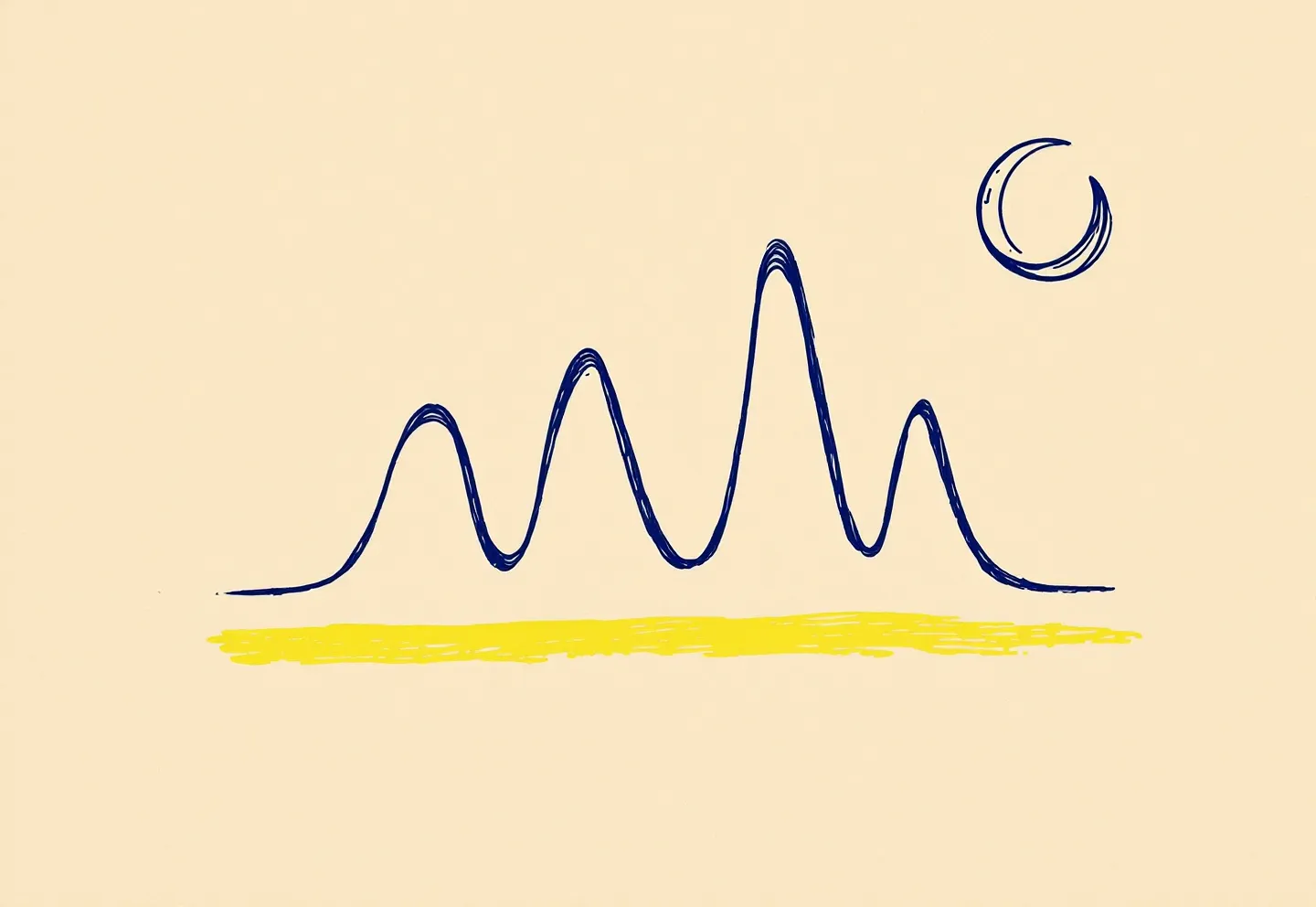
Vittone and colleagues published a 1997 short-duration study in Metabolism showing that six weeks of nightly subcutaneous GHRH(1-29) in healthy elderly men nearly doubled 12-hour mean GH release versus baseline, with modest increases in IGF-1 and lean body mass [4]. The trial was small but it established the basic GH-pulse response in older men using essentially the sermorelin molecule.
The Baker trial published in Archives of Neurology in 2012 went further [6]. One hundred thirty-seven older adults — 76 healthy and 61 with mild cognitive impairment — received 1 mg/day of a GHRH analog subcutaneously for 20 weeks. Cognitive function improved on the intent-to-treat analysis (P=0.03), with executive function showing the strongest effect (P=0.005). IGF-1 rose by 117% but remained within the physiological range. Body fat fell by 7.4% and lean mass rose 3.7%. Adverse events ran 68% on active versus 36% on placebo, primarily local skin reactions at the injection site and joint pain — both consistent with the GH-class side-effect signature [6].
The Baker trial is the most rigorously designed published study of a GHRH analog in older adults to date. It does not establish a clinical indication, and the authors did not propose one. It does establish that the GHRH-receptor mechanism produces measurable physiologic and cognitive effects in this population at this dose for this duration.
The class context: tesamorelin and the HIV-lipodystrophy literature
Sermorelin is the prototype short-acting GHRH analog. Two molecules in the same class were later developed for extended duration: tesamorelin (a trans-3-hexenoyl modification at the N-terminus) and CJC-1295 (a GHRH(1-29) analog with substitutions that resist dipeptidyl peptidase-IV cleavage, with or without a DAC component that extends half-life further) [9].
Koutkia and colleagues published a 2004 randomized controlled trial in JAMA showing that 1 mg of GHRH twice daily for 12 weeks in HIV-positive men with lipodystrophy raised IGF-1 by 104 ng/mL versus 6 ng/mL on placebo (P=0.004), increased lean mass by 0.9 kg, and reduced trunk fat by 0.4 kg [5]. Stanley and colleagues published a 2019 Lancet HIV trial showing that 12 months of tesamorelin reduced hepatic fat fraction and slowed fibrosis progression in HIV-associated non-alcoholic fatty liver disease [11].
A 2026 meta-analysis of tesamorelin trials in HIV-associated lipodystrophy confirms the class-level efficacy in reducing visceral fat and hepatic steatosis with stable glycemic safety [13]. The reason the tesamorelin literature matters for a sermorelin reading is mechanism: the two molecules act at the same receptor through the same Gs/cAMP/PKA pathway. The pharmacokinetic profiles differ, but the biology does not.
The Frohman protease story
One of the more elegant papers in the sermorelin lineage is Frohman's 1994 demonstration that substituting D-alanine at position 2 of GHRH(1-29) protects the molecule from cleavage by dipeptidyl peptidase-IV (DPP-IV) and roughly doubles its plasma half-life in healthy men [16].
That is the pharmacokinetic foundation for every stabilized GHRH analog that followed. The vulnerability of native sermorelin to DPP-IV cleavage at the N-terminus is precisely why CJC-1295 carries a D-Ala2 substitution and why tesamorelin carries the trans-3-hexenoyl-Tyr1 modification — both protect the same vulnerable amide bond. The Frohman paper is also why dosing strategies for native sermorelin have always concentrated on rapid-onset nightly subcutaneous use rather than continuous infusion: with an 11-minute half-life, continuous dosing simply isn't a useful schedule [16][7].